Showing posts with label Religi. Show all posts

Al-Khwarizmi - Islamic Mathematics

11:05 am 0

One of the first Directors of the House of Wisdom in Bagdad in the early 9th Century was an outstanding Persian mathematician called Muhammad Al-Khwarizmi. He oversaw the translation of the major Greek and Indian mathematical and astronomy works (including those of Brahmagupta) into Arabic, and produced original work which had a lasting influence on the advance of Muslim and (after his works spread to Europe through Latin translations in the 12th Century) later European mathematics.
The word “algorithm” is derived from the Latinization of his name, and the word "algebra" is derived from the Latinization of "al-jabr", part of the title of his most famous book, in which he introduced the fundamental algebraic methods and techniques for solving equations.
Perhaps his most important contribution to mathematics was his strong advocacy of the Hindu numerical system, which Al-Khwarizmi recognized as having the power and efficiency needed to revolutionize Islamic and Western mathematics. The Hindu numerals 1 - 9 and 0 - which have since become known as Hindu-Arabic numerals - were soon adopted by the entire Islamic world. Later, with translations of Al-Khwarizmi’s work into Latin by Adelard of Bath and others in the 12th Century, and with the influence of Fibonacci’s “Liber Abaci” they would be adopted throughout Europe as well.


Al-Khwarizmi’s other important contribution was algebra, a word derived from the title of a mathematical text he published in about 830 called “Al-Kitab al-mukhtasar fi hisab al-jabr wa'l-muqabala” (“The Compendious Book on Calculation by Completion and Balancing”). Al-Khwarizmi wanted to go from the specific problems considered by the Indians and Chinese to a more general way of analyzing problems, and in doing so he created an abstract mathematical language which is used across the world today.
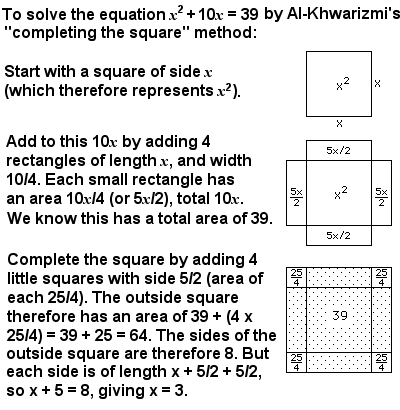
His book is considered the foundational text of modern algebra, although he did not employ the kind of algebraic notation used today (he used words to explain the problem, and diagrams to solve it). But the book provided an exhaustive account of solving polynomial equations up to the second degree, and introduced for the first time the fundamental algebraic methods of “reduction” (rewriting an expression in a simpler form), “completion” (moving a negative quantity from one side of the equation to the other side and changing its sign) and “balancing” (subtraction of the same quantity from both sides of an equation, and the cancellation of like terms on opposite sides).
In particular, Al-Khwarizmi developed a formula for systematically solving quadratic equations (equations involving unknown numbers to the power of 2, or x2) by using the methods of completion and balancing to reduce any equation to one of six standard forms, which were then solvable. He described the standard forms in terms of "squares" (what would today be "x2"), "roots" (what would today be "x") and "numbers" (regular constants, like 42), and identified the six types as: squares equal roots (ax2 = bx), squares equal number (ax2c), roots equal number (bx = c), squares and roots equal number (ax2 + bx = c), squares and number equal roots (ax2 + c = bx), and roots and number equal squares (bx + c = ax2).
Al-Khwarizmi is usually credited with the development of lattice (or sieve) multiplication method of multiplying large numbers, a method algorithmically equivalent to long multiplication. His lattice method was later introduced into Europe by Fibonacci.

In addition to his work in mathematics, Al-Khwarizmi made important contributions to astronomy, also largely based on methods from India, and he developed the first quadrant (an instrument used to determine time by observations of the Sun or stars), the second most widely used astronomical instrument during the Middle Ages after the astrolabe. He also produced a revised and completed version of Ptolemy's “Geography”, consisting of a list of 2,402 coordinates of cities throughout the known world.


Src : SM
Eo : Ahmad Zaman Huri

3 Do’a Yang Paling Sering Diucapkan (Bahasa Inggris dan Artinya)

6:13 pm 0

Berdo’a merupakan sebuah kegiatan atau aktifitas yang dilakukan untuk meminta atau memohon kepada Tuhan akan suatu hal. Setiap agama memiliki caranya tersendiri untuk berdoa dan berdoa pun bisa dilakukan menggunakan berbagai macam bahasa. Salah satunya yaitu menggunakan bahasa inggris. 
Berikut saya akan memaparkan sedikitnya 3 saja do'a dalam bentuk bahasa inggris. Selamat membaca 😊

1. Do’a sebelum makan
Dear god, thankyou for all the blessing that you gave for us and thank you for the foods that you gave for us. Now, I want to eat, so please bless the food. Inorder, it can make me healthy. Thankyou god
Tuhanku, terimakasih untuk semua karunia yang telah Engkau berikan kepada kami dan terimakasih untuk makaan yang engkau berikan kepada kamu. Sekarang, aku ingin makan,. maka karuniakanlah berkat mu pada makanan ini., agar supaya makanan ini dapat menjadi sehat bagi ku. Terimakasih Tuhan

2. Do’a Sebelum Tidur 
Thankyou God for today, thankyou for all your guidance, thank for all the people I met, thanks for the activities I could do, Thanks for this love in my heart. Now, I am going to sleep, may your angel sorround me and keep me in good sleep tonight. I will wake up and give thanks to you. Thankyou God.
Terimakasih Tuhan untuk hari ini, terimakasih atas petunjuk mu, terimakasih untuk semua orang-orang yang aku temui, terimakasih untuk aktifitas yang telah dapat aku lakukan. Terimakash untuk rasa cinta yang ada di hatiku. Saat ini aku akan pergi tidur, semoga malaikat mu berada di sampingku dan menjaga tidur malam ku. aku akan bangun esok dan berterimakasih pada mu. Terimakasih Tuhan.

3. Do’a Sebelum Belajar
God, I would to say thank you because you have let us study here please bless our teacher and parents, God we would like to be smart and diligent children.
Tuhan, aku akan mengucapkan terimakasih pada mu karena engkau telah mengizinkan kami belajar disini tolong berkati kami dan oragtua kami, Tuhan kami ingin menjadi anak-anak yang pintar dan rajin  
 
Mungkin untuk kali ini itu saja do'anya. Semoga iman kita makin kuat dan mendapat keridhaan dariNya.

SEMOGA BERMANFAAT^^


Eo : Ahmad Zaman Huri
Src : Kbi 

Bolehkah wanita Azan dan Iqamah?

5:52 pm 0

Sebelum salat lima waktu disunnahkan untuk azan dan iqamah kepada laki-laki. Namun apakah azan dan iqamah juga disunnahkan kepada wanita?
Dalam banyak literatur kitab klasik disebutkan mereka kaum wanita tidak disunnahkan azan. Sedangkan iqamah saja yang disunnahkan dengan beberapa syarat untuk sesama wanita dan  tidak untuk laki-laki yang bukan mahramnya.
"Disunahkan iqamah saja bagi wanita untuk dirinya dan untuk sesama kaum wanita tidak iqamah untuk kaum laki-laki, kaum banci. Disunahkan juga iqamah bagi banci untuk dirinya dan kaum wanita namun tidak untuk kaum laki-laki" (Syekh Ibnu Hajar Al-Haitami, Kitab Minhaj al-Qawiim I:149)
Sementara itu azan tidak disunnahkan kepada wanita, namun apabila dengan suara pelan-pelan dan juga sesama mereka wanita dibolehkan.
Hal ini juga disebutkan dalam kitab Minhaj Al-Qawim, bunyinya: "Sedangkan azan maka tidak disunahkan bagi wanita secara mutlak, namun bila ia azan secara pelan untuk dirinya atau untuk sesamanya (wanita) diperbolehkan. Bila azannya dengan keras dalam batas di luar yang dia perdengarkan pada teman-temannya, di sana ulama berpendapat keharaman melihat wajah wanita karena khawatir menimbulkan fitnah begitu dengan suaranya."
(Syekh Ibnu Hajar Al-Haitami, Kitab Minhaj al-Qawiim I:149)
Pernyataan hampir senada juga disebutkan dalam kitab Lanah At-Thalibun, dengan bunyinya: "Disunahkan iqamah bagi wanita dengan suara pelan, demikian pula waria. Bilamana seorang wanita azan sesama wanita dengan suara pelan maka tidak makruh, atau dengan suara keras maka haram. Kalimat “disunahkan iqamat bagi wanita” yakni bagi dirinya atau sesama wanita, bukan terhadap para pria dan waria. Tidaklah disunahkan bagi wanita azan secara mutlak. (Kitab I’anah al-Thalibin I: 233).

Eo : Ahmad Zaman Huri
Src : por.sa